

Your Enterprise Website Is Quietly Killing Your Pipeline
A Houston B2B technical leader breaks down the enterprise website architecture decisions that disqualify companies before the first sales call happens.


Is Your Enterprise Website Actually Costing Your Sales Team Pipeline?
Yes. And more precisely than most heads of sales realize.
At Ingenia, we've watched B2B industrial and enterprise sales teams lose qualified opportunities — to technical failures baked into their own website architecture. The procurement reviewer hit a timeout on a gated content page. The product subdomain wasn't indexed by Google. An accessibility reviewer who relied on a screen reader couldn't get through the RFQ flow. The company never knew. The deal was already gone.
This post isn't about design. It's about the structural decisions made at the start of a build, or inherited from the last agency, that sit silently underneath a beautiful site and bleed pipeline every quarter.
Why Marketing Says "The Site Is Fine" (And Why That Answer Is Wrong)
Marketing is measuring what their tools show them. Session counts look stable. Bounce rate is acceptable. The last redesign got internal applause and a few LinkedIn posts. From a campaign attribution standpoint, the site "converted" a handful of demo requests last month, so the dashboard is green.
What marketing isn't measuring is the enterprise buyer who spent 11 seconds on your capabilities page, got a 4.2-second first contentful paint on hotel WiFi in Midland, and closed the tab. That's not a bounce. That's a disqualification. And it happens before your sales team ever gets an alert in Salesforce.
Google's Core Web Vitals data shows that pages meeting "Good" thresholds across LCP, FID, and CLS see meaningfully higher conversion rates than pages that fail even one metric. For enterprise B2B, where the buyer's research phase is longer and the scrutiny is higher, a sluggish page doesn't get a second chance. The buyer moved on to your competitor, who happened to have a faster server response time that day.
Three Technical Failures We've Actually Seen Kill B2B Deals
1. Slow TTFB on Gated Content Pages
Time to First Byte measures how long a browser waits before receiving the first byte of data from a server. A "Good" TTFB is under 800ms. We've audited enterprise sites running on shared hosting or legacy CMS platforms that were delivering TTFB values north of 2,400ms on gated assets — whitepapers, case studies, product spec sheets. These are exactly the pages a procurement team visits when they're evaluating a vendor.
The scenario that keeps coming up: a buyer on the shortlist fills out the gated form to access a technical datasheet. The page stalls. They hit refresh once. It stalls again. They either abandon the asset entirely or, worse, they form an impression of your company's operational competence based on that experience. If your systems integration pitch is "we build reliable enterprise infrastructure," a 3-second server response time is a credibility problem, not just a technical one.
The root cause is almost always the same: a poorly configured origin server, no CDN layer, or a database-heavy page generation process with zero caching strategy. These are fixable. They just require someone to actually look at the infrastructure rather than the front-end design.
2. Non-Indexed Product Subdomains
This one is genuinely painful to diagnose after the fact. A surprisingly common architecture decision — especially for companies that have grown through acquisition or manage multiple product lines — is to host product catalogs or technical documentation on subdomains: products.company.com, docs.company.com, specs.company.com. The main domain ranks and gets traffic. The subdomains sit orphaned.
We've seen this with energy sector clients in Texas where product specification pages were hosted on a subdomain that got inadvertently blocked in robots.txt during a migration. Those pages weren't appearing in search results for the exact technical queries their buyers were running. The sales team fielded calls where prospects said, "I couldn't find your product specs online," and the response was usually a manual PDF email. That's a 2015 sales motion being executed in a world where, according to Forrester's 2023 B2B Buying Study, 70 percent of B2B buyers want to self-educate before engaging a rep.
The fix is a crawl audit, a robots.txt review, an XML sitemap that covers subdomain URLs if they should be indexed, and often a decision to consolidate subdomains under the primary domain with proper redirect architecture. None of this is exotic. All of it requires someone with a technical mandate to look.
3. Accessibility Failures That Block Procurement Reviewers
This is the one that gets the least attention and probably causes the most damage in regulated industries. Enterprise procurement processes, particularly in manufacturing, energy, and government-adjacent sectors, frequently involve reviewers with disabilities. Screen reader incompatibility, missing alt text on product images, unlabeled form fields in RFQ flows, poor keyboard navigation — these aren't just WCAG 2.1 compliance issues. They're deal-blocking friction that you'll never hear about.
WebAIM's 2024 accessibility analysis of the top one million web homepages found that 95.9 percent had detectable WCAG failures. For enterprise B2B sites, the homepage is usually the most carefully maintained page. The problem gets worse deeper in the site, on product pages, documentation, and form flows that rarely get the same QA attention.
The practical implication for a head of sales: if a procurement office assigns a reviewer who relies on assistive technology to evaluate vendors, and your competitor's RFQ form is navigable via keyboard while yours isn't, you just lost that evaluation before the technical review started. Nobody will tell you that's why you lost. The debrief will cite "fit" or "pricing."
Where Ingenia Has Gotten This Wrong
We've shipped sites that had these problems. That's the honest version of this post.
Early in a few engagements, particularly ones where the client had strong opinions about their existing CMS and we didn't push back hard enough, we built on platforms that couldn't deliver acceptable performance at the infrastructure level. The design was solid. The content strategy was good. The site launched on a WordPress instance running on a shared server with a caching plugin that the client's internal team eventually disabled because it was "causing layout issues." Six months later, TTFB was over 2,000ms on key service pages and nobody connected that to the stalled inbound pipeline.
That lesson is now built into how we scope engagements. Before any visual design work starts, we do an architecture decision record covering CMS, hosting, CDN, and deployment pipeline. If a client insists on a platform that can't meet performance benchmarks for their traffic patterns and content types, that conversation happens in writing before we start — not after launch when the sales team is frustrated and marketing is defensive.
Headless CMS architectures built on platforms like Contentful, Sanity, or Hygraph, paired with static site generation or edge-rendered front ends via frameworks like Next.js, have been the most reliable path to consistent performance for the enterprise B2B sites we build today. Separating content management from front-end rendering eliminates most of the TTFB problems that plague monolithic CMS deployments. That said, headless isn't a performance guarantee. A poorly configured headless deployment can still deliver bad Core Web Vitals. The architecture makes good performance possible. The implementation determines whether you actually get it.
What Should a Head of Sales Actually Do With This?
You're not going to become a web performance engineer. You don't need to. But you can ask specific questions that force accountability.
- Ask for a Core Web Vitals report from Google Search Console, specifically for the pages in your conversion funnel, not just the homepage. If marketing can't produce this in 10 minutes, that's diagnostic in itself.
- Ask whether your product subdomains are indexed. Run a site:products.yourcompany.com search in Google. If you see pages, they're indexed. If you see nothing, you have a conversation starter.
- Run your RFQ or demo request form through the WAVE accessibility tool at wave.webaim.org. It's free and takes three minutes. Errors on form labels or missing ARIA attributes give you a documented problem to escalate.
- Ask what the TTFB is on your most important gated content pages. Use WebPageTest.org with a throttled connection profile to simulate a buyer on a mid-tier mobile connection. Over 800ms means you've got a solvable infrastructure problem.
These aren't gotcha questions. They're diagnostic tools that give you data to bring to a conversation with marketing and technology leadership. The goal is to fix the architecture before the next enterprise opportunity walks through your funnel and quietly disappears.
Does Website Architecture Actually Affect Enterprise Sales Conversion?
Attribution here is genuinely hard. You can't directly observe the buyer who bounced from a slow page and went to a competitor. What you can measure is population-level behavior. Google's Core Web Vitals data shows that meeting Good thresholds correlates with lower bounce rates and higher session depth. For B2B industrial and enterprise sites where a single closed deal can represent six or seven figures in revenue, even a marginal improvement in qualified visitor engagement pays for the infrastructure investment in a single deal cycle.
The more defensible framing for a head of sales is risk elimination rather than conversion lift. A site with slow gated pages, non-indexed product documentation, and accessibility failures is an active liability. It creates conditions under which your best prospects can silently disqualify you. Fixing the architecture doesn't guarantee pipeline. Leaving it broken guarantees leakage.
If you're in Houston, Dallas, Austin, or anywhere else in Texas running an enterprise B2B sales motion and your site hasn't had a proper technical audit in the last 12 months, the probability that one or more of these issues is present is high. We see it consistently across industrial, energy, and manufacturing accounts. The site looks fine. The architecture isn't.
Ingenia's digital marketing services and software development practice both start with the technical foundation before any campaign or design work begins — specifically because we've learned the hard way that beautiful execution on broken infrastructure is a liability disguised as a brand asset. If you want to understand what your site's architecture is actually doing to your pipeline, let's start there.
About Ingenia: Ingenia is a Houston, Texas digital marketing and AI development agency serving B2B industrial, energy, and enterprise clients. We build the technical infrastructure that makes sales teams' jobs easier. Not affiliated with Ingenia Technologies. Reach out at ingenia.com/#contact.
More from Ingenia
The New Industrial Shelf Is the AI Answer
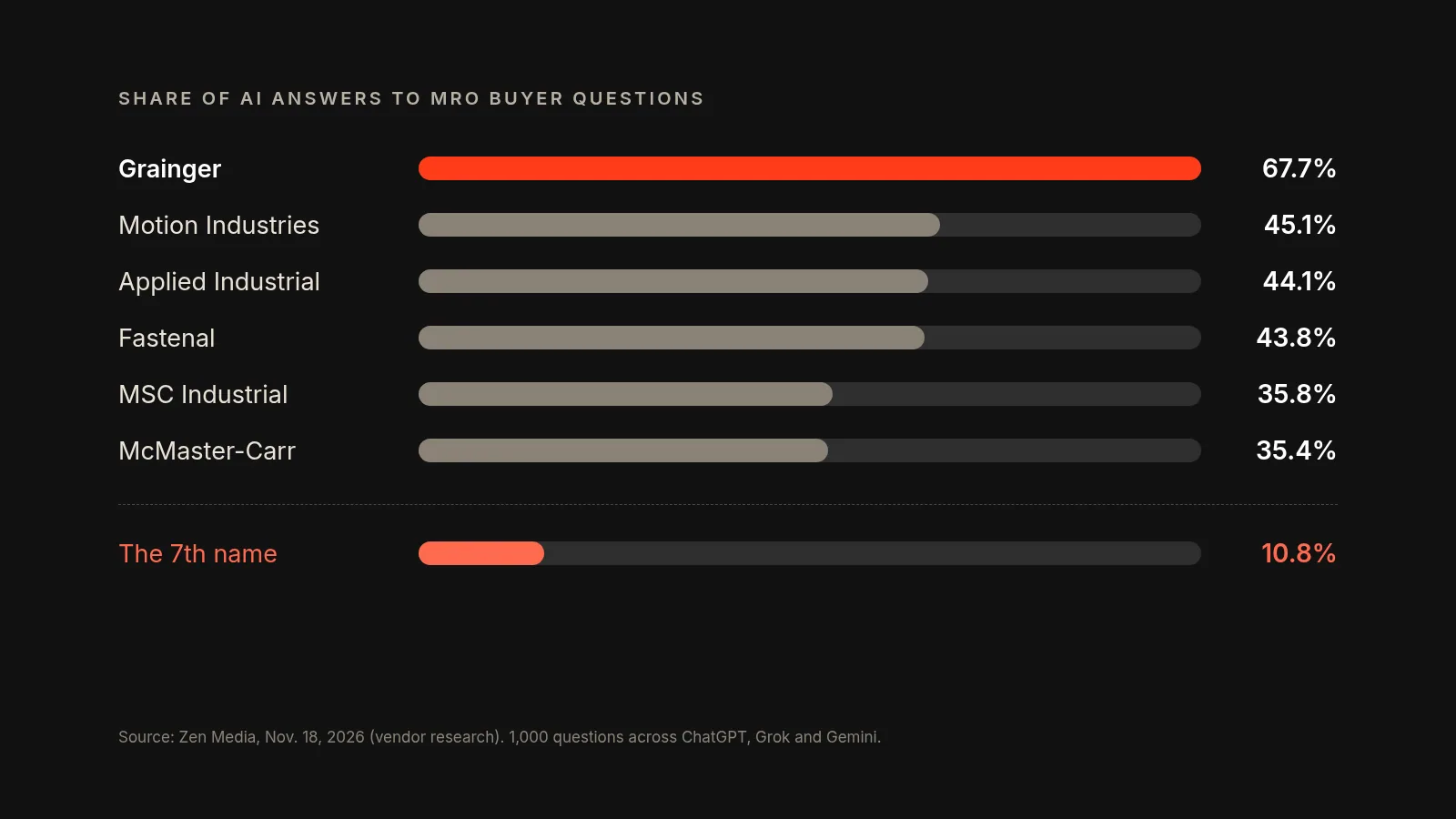
When a plant engineer or procurement lead asks ChatGPT who to buy from, six distributors show up. Almost everyone else disappears. Two new studies explain why, and what manufacturers should do next.
Pablo Hernandez O'Hagan · Nov 19

Your Sales Deck Is the Most Expensive PDF Nobody Asked For
AI search engines are answering B2B buyer questions before your reps get a call. Here's why Houston sales leaders need AEO more than a better pitch deck in 2026.
Lance Bricca · Nov 18

AI Search Is Answering Your Customers. Is Your Bank in the Answer?
A tactical AEO playbook for bank and credit union marketing directors in Houston, Texas and beyond who need B2B and retail financial services visibility in AI search results.
Lance Bricca · Nov 16