

The New Industrial Shelf Is the AI Answer
When a plant engineer or procurement lead asks ChatGPT who to buy from, six distributors show up. Almost everyone else disappears. Two new studies explain why, and what manufacturers should do next.
hen a plant engineer or procurement lead asks ChatGPT who to buy from, six distributors show up. Almost everyone else disappears. Two new studies explain why — and what manufacturers should do next.
Is AI already building the shortlist for industrial buyers?
Yes. And the drop-off after the leaders is steep.
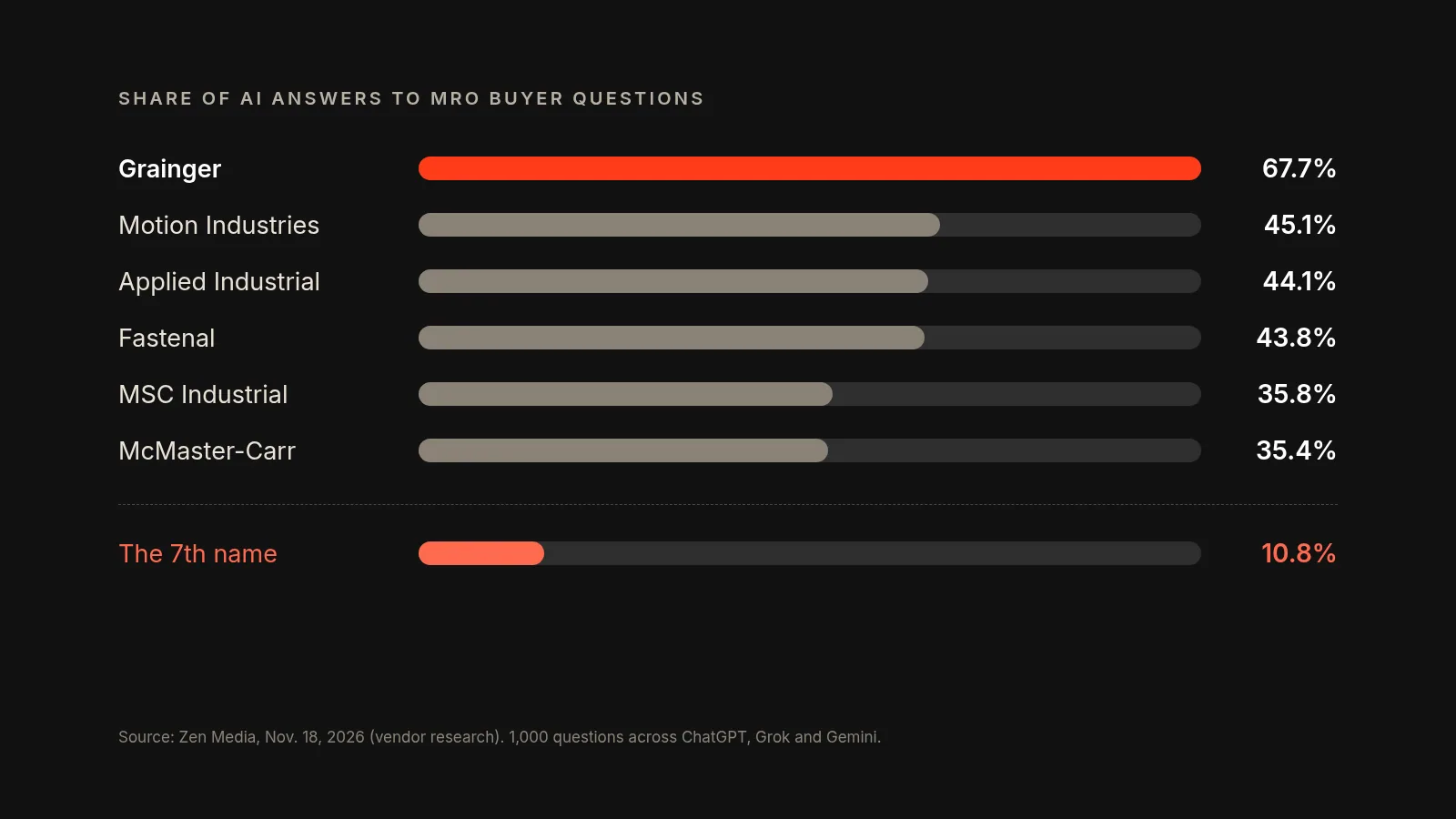
MRO means maintenance, repair, and operations supplies — the parts, tools, and materials plants buy to keep running. Zen Media, an AI-visibility agency, ran 1,000 buyer questions about industrial parts and MRO through ChatGPT, Grok, and Gemini, and analyzed 3,000 responses. This is vendor research, not an independent academic study. The pattern is still useful.
Grainger showed up in 67.7% of those answers. The next five all cleared 35%:
Motion Industries, 45.1%
Applied Industrial Technologies, 44.1%
Fastenal, 43.8%
MSC Industrial Supply, 35.8%
McMaster-Carr, 35.4%
The seventh name fell to 10.8%.
That is the new shelf. Not a distributor aisle. The AI answer.
If you are not in that answer, you are not in the conversation. The buyer never knows you were an option. Your sales team never knows the buyer existed.

The engines don't even agree with each other
Visibility in this study means how often a company name appears in the answers. It does not measure whether the engine links to your website, or whether it describes your parts correctly.
The engines also disagree. McMaster-Carr shows up in 47.2% of Gemini summaries, but only 18.9% of Grok's — about two and a half times as often in Gemini. The same buyer, asking the same question, can get a different shortlist depending on which tool they open.
Zen Media's CEO, Sarah Evans, put it plainly: industrial buyers are prompting AI with exact parts, specs, and applications, and the answers change as those requirements get more specialized. Every distributor should know two things — whether they show up, and whether AI describes their parts and applications correctly.
That second question matters as much as the first. Showing up in the wrong context is almost as expensive as not showing up at all.
Industrial AI is stuck in the Frozen Middle
Getting onto that shelf is a content and visibility problem. Staying there, and actually using AI inside the commercial organization, is an operating-model problem.
Adobe and Incisiv surveyed 467 people in industrial manufacturing as part of a broader study of 5,633 executives. They call the stall the "Frozen Middle." This is also vendor research, and the numbers are worth using carefully.
58% of respondents are still piloting or deploying. The median company gets 13 of every 100 proposed use cases into production, below the global average of 15. Only 13% have a dedicated AI owner with a formal title and budget authority. Just 1% report fully integrated, enterprise-accessible customer data. And yet 82% of marketing leaders are now expected to contribute directly to revenue.
Revenue accountability is mandated. The data to earn it is structurally out of reach.
The holdup is not the tools. Adobe's conclusion matches what we see in client work: the barrier is how the company is organized to use AI. Scaling a use case in this sector pulls channel, service, data, risk, and technology teams across boundaries that were built for long capital cycles, not rapid iteration. When authority stops at every function's edge, the use case stalls at IT review, security, integration, or budget — before anyone can test whether it would work commercially.
You can see the same shift on the go-to-market side. Platforms are starting to give each contact in account-based marketing — ABM, meaning a program aimed at specific accounts rather than a broad audience — its own AI agent, with goals, limits, and a log of every action. Conversion's new Orchestrator is one early example. The agencies that win that work will sell the strategy, the content, and the oversight around the agents, not just the automated workflows.
What should manufacturers and distributors do now?
Two moves. One is about being found. The other is about being able to act.
Run an AI Shelf Audit. Write a fixed set of the buyer questions your customers actually ask — parts, specs, applications, locations — and run them through ChatGPT, Gemini, and Grok. Score where you show up, where competitors show up, and how the engines describe you. Then improve the technical content on your site and the coverage of your products on third-party sites, and measure the same questions again every month. This is the industrial version of knowing whether you are on the shelf at the distributor. The shelf has moved.
Name an AI owner. Many mid-market manufacturers have nobody who owns AI full time. Adobe's data says the organizations that scale are 7.2 times more likely to have a formal AI owner with the mandate and budget to work across functions. If you cannot hire that role yet, appoint a part-time commercial AI lead — someone who can take one use case from first measurement to production, in demand generation, channel sales, or aftermarket. Pick one use case. Define the outcome and the baseline before you start. Map the data and governance dependencies while you can still change them.
Neither move requires a 40-project AI roadmap. Both require someone to be accountable for the result.
The flywheel doesn't start if you're invisible
At Ingenia, we use a four-stage operating model we call the Industrial Flywheel. Clear positioning attracts the right audience. The right audience converts more efficiently. Efficient conversion increases revenue. Revenue funds reinvestment in the system.
If a buyer asks an AI engine for a supplier in your category and you do not appear, the flywheel never turns. Positioning that only lives in a sales deck or a trade-show booth does not reach the research session that now happens before the first call.
That is the work to do now: get on the new shelf, and give someone in the company the authority to keep you there.
If you want an AI-shelf check for your category — a scored set of buyer questions, a read on how the engines describe you, and a plan to improve it — we do this work. Talk to us.
About Ingenia: Ingenia is a Houston, Texas digital marketing and AI development agency serving B2B industrial, energy, and enterprise clients, with a bilingual team in Houston and Mexico City. We help manufacturers and distributors build the visibility, content, and operating model that get them onto the shortlist before the first sales call. Not affiliated with Ingenia Technologies. Talk to us.
Sources:
Zen Media, "AI Visibility for Industrial Parts & MRO Distributors," November 18, 2026, via GlobeNewswire (vendor research)
Adobe and Incisiv, "In industrial manufacturing, AI stalls between systems, not on ambition," November 17, 2026 (vendor research)
More from Ingenia

Your Sales Deck Is the Most Expensive PDF Nobody Asked For
AI search engines are answering B2B buyer questions before your reps get a call. Here's why Houston sales leaders need AEO more than a better pitch deck in 2026.
Lance Bricca · Nov 18

AI Search Is Answering Your Customers. Is Your Bank in the Answer?
A tactical AEO playbook for bank and credit union marketing directors in Houston, Texas and beyond who need B2B and retail financial services visibility in AI search results.
Lance Bricca · Nov 16

Your Best Relationship Is Killing Your Pipeline
An open letter to industrial distributor BDs: the single trusted contact you're proudest of may be the biggest structural risk in your Houston B2B sales pipeline.
Pablo Hernández O'Hagan · Nov 13